



Welcome to our Nature Guide
Never touch a cave decoration. They are always delicate. Even the oil from your fingertip will change the flow of water across their surface, perhaps changing their growth for eons. It doesn't make sense to take souvenirs either. Cave decorations are never as colorful outside a cave as they are in their natural setting. Limestone caves are so fragile that SeaCanoe will never commercialize a drycave. However, with a trained guide ina sea kayak, non-impact, low volume caveentries are possible because they don't require permanent lights or footpaths. Even body heat is carried out of the caves by the winds and changing tides running through tidal sea caves.
All sea caves are fascinating. When the tumultuous surf inside California and Hawai'i sea caves combines with echoing sound effects, it is certainly exciting. Although Asia's tidal sea caves seem sedate, they are packed with flowstone and backed by Garden of Edens called "Hongs." Traversing these oyster-filled cavities can be quite dangerous on Spring tides if your guide doesn't know what he's doing (Ours do!). Each time the tide changes, it eats a few molecules from the limestone. Naturally, the water works into cracks (faults) in the rocks, eating them wider and deeper with each tidal change. Not only are Asia's caves beautiful, they can be much deeper than surf caves. Thailand has a 2K cave in the Far South, and Halong Bay has a 3K sea cave. When sea waters follow a fault line to meet up with standing water in a dolite, a Hong begins to form. The tides eat away the rubble and create a nape, which gradually shears the cliffs away until they are vertical, turning the coffee filter into a cylinder. A Hong is born.
When tidal sea caves meet up with sump holes, a tidal Hong is born. Once tides
pour through the cave, the erosion process increases, eating away at the base of the
Hong until the cliffs become cylindrical. Eventually even a tidal nape is formed inside The walls of the Hong are a limestone donut. By our definition, cliffs must meet in an unbroken circle to qualify as a true Hong. Percolation runs down the same fault line that allows the tidal cave, creating decorations and eating away at the cave ceiling. Even so, ceilings are basically at the highest tide level. Mud/rock/oyster fragment cave floors generally fill up to mid-range tide levels. Mangroves are sparse in Phang Nga's islands, although coastal mud flats are carpeted with green. The Mangrove Hong was named because of it's thick forests, but over-volume created by destructive group tours seriously reduced the Mangrove Hong's population by 75%. One species near the cave entrance disappeared entirely because other operators allowed guests to climb and break the trees, and ran their kayaks over the seedlings. Hongs," today's big attraction!
|
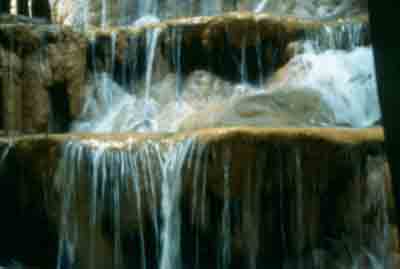 Flowstone is created when water saturated with limestone particulates evaporates. (Particulates are microscopic granules of rock so small they are either bonded to, or suspended between water molecules.) When the water evaporates, it leaves molecules of particulate on the base rock, eventually forming a stalactite or "waterfall."
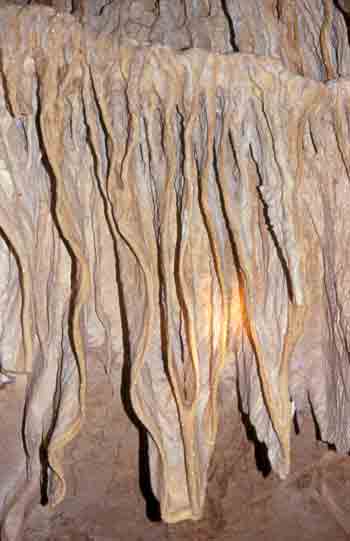 Stalactites are by far the most amazing cave decorations. They seem to hang down from cave ceilings, exterior cliffs, and overhangs. Every time you see a stalactite, there's a water source flowing above, rain that dripped down through the entire island.
  saturation and amount of windflow. (Wind increases evaporation, and influences the shape of flowstone.)
 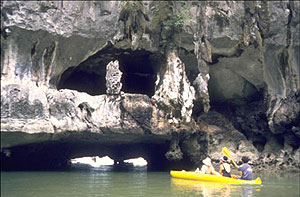 Oyster Cave on North Panak shows two levels of tidal napes. The upper level was created when the sea level was five meters higher, and is called a balcony. Both caves are created by tidal erosion, and run "over-under" parallel because they share the same fault line.Stains on the left and stalactites in the upper cave both result from percolation
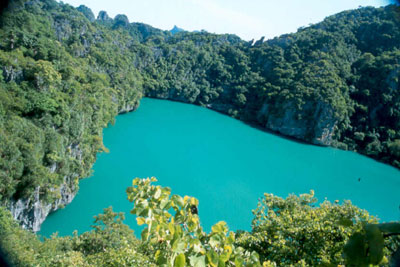 Sump holes, or dolites, are common the world over. The big difference in
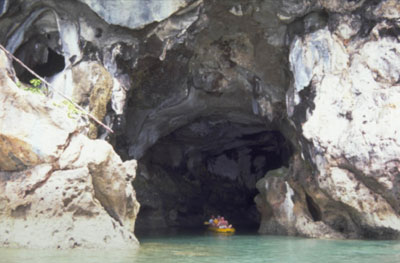 The Bat Cave entrance shows a balcony nape on the right, and the balcony remains on the left.The cliff face entrance is along a fault line. The balcony has been corroded away the length of the cave by heary percolation, which is seen by the inner cave's high ceilings and the aged stalactites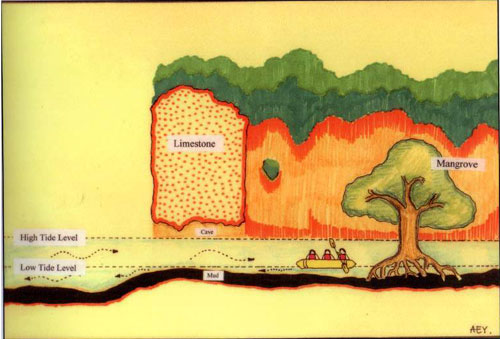
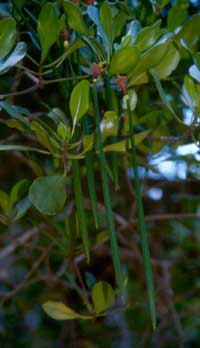
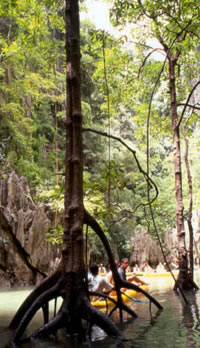
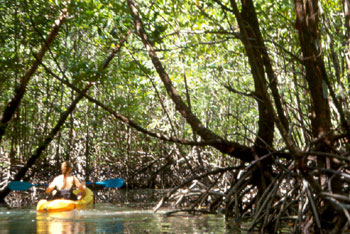 "Forests of the Sea", mangroves literally create the swamps where marine life eventually crawled onto land. Mangroves' water-born seeds range between the Tropics,
creating sanctuary for young life from both land and sea, and creating new land in the process. All mangroves need is still sea water.Mangroves are unique because they live in salt water,
which means the water level and salinity changes with the
tides. Their distinctive stilt roots keep them upright, and they secrete salt through their succulent leaves.
"Forests of the Sea", mangroves literally create the swamps where marine life eventually crawled onto land. Mangroves' water-born seeds range between the Tropics,
creating sanctuary for young life from both land and sea, and creating new land in the process. All mangroves need is still sea water.Mangroves are unique because they live in salt water,
which means the water level and salinity changes with the
tides. Their distinctive stilt roots keep them upright, and they secrete salt through their succulent leaves.
Informations
- Lagoon, Hongs, Caves
- Animals of Phang Nga Bay
- Birds of Phang Nga Bay
- Nature Guide
- Flowstone
- Year-Round Season
